

Most organisations across Singapore have experimented with AI. Chatbots were tested. Tools were trialled. Early wins looked promising. And then — almost universally — scaling stalled.
AI pilots succeed in isolation and fail at integration. They demonstrate a tool rather than transform a process. Teams use the tool inconsistently, governance remains undefined, and AI stays "on the side" — present in the organisation but never embedded in how work actually flows.
In 2026, the businesses pulling ahead are the ones that understood this earlier. They stopped asking "What AI tool should we use?" and started asking "How should this business run differently?" That shift turns AI from an experiment into an operational asset — one that compounds in value over time.
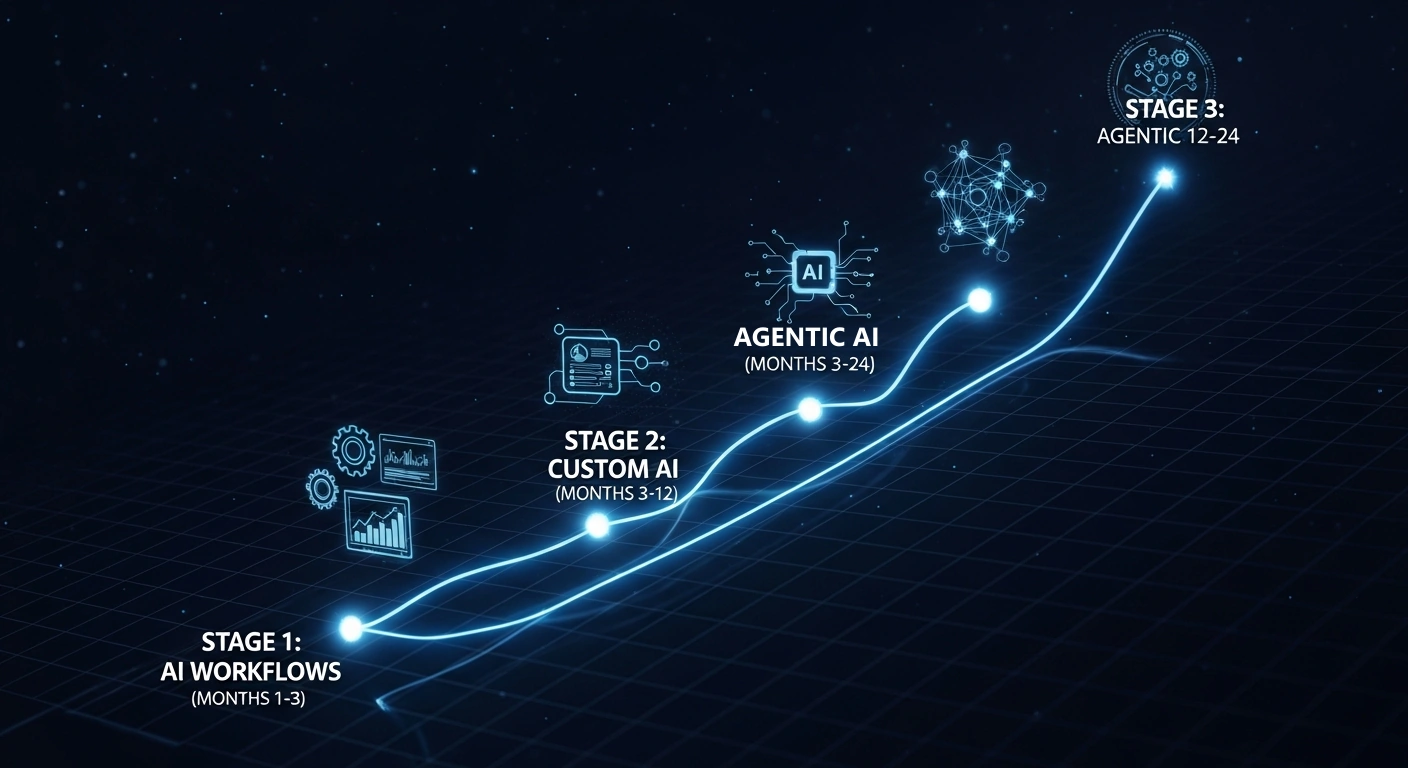
This guide walks through the three-stage AI transformation model that Avernixx uses with Singapore SMEs and enterprises — from workflows through custom AI to agentic systems — and how businesses are reaching a fully operational agentic AI workforce within 24 months.
Why AI Pilots Fail in Singapore
Singapore businesses are well-supported in AI adoption. PSG stopped taking new applications on 29 Sep 2026, and the EDGE Grant replaced PSG, EDG and MRA from 30 Sep 2026. EDGE pays up to 50% for SMEs, with up to S$30,000 a year for digital solutions. The Enterprise Innovation Scheme offers tax deductions and cash payouts. IMDA's Model AI Governance Framework provides a structured roadmap. The funding environment is as strong as anywhere in the world.
Yet the failure rate of AI pilots remains high. Not because of money or tools — but because of approach.
The Three Root Causes of AI Pilot Failure
Disconnected from real workflows.The tool is deployed alongside existing processes rather than integrated into them. Staff choose between the old way and the AI-assisted way. Most choose the old way — because the path of least resistance is always the familiar one.
Undefined governance.Nobody is accountable for what the AI system does. There are no approval checkpoints, no audit trails, no monitoring. When something unexpected happens — and it will — there is no framework for response.
Wrong starting point.Organisations try to begin with complex problems — strategic decision support, customer-facing AI, autonomous agents — before establishing the operational foundation those systems require. The result is fragile systems that impress in demos and break in production.
The organisations that succeed take a staged approach. They start where the impact is immediate and the risk is low. They build the foundation before the complexity. And they embed governance from day one rather than bolt it on later.
Stage 1: AI Workflows — Removing Friction From Day One
The most reliable starting point for AI transformation is the workflow: a repeating, structured process that consumes significant staff time, follows consistent rules, and has clear measurable outputs.
For Singapore businesses, the most common first targets are accounts payable and invoice processing, HR onboarding and offboarding documentation, IT helpdesk ticket routing and initial response, lead qualification and sales follow-up, purchase order and procurement management, and regulatory reporting preparation.
These workflows do not require sophisticated AI models or complex data infrastructure. They require a process that is clearly defined and a willingness to run it differently.
What an AI Workflow Actually Looks Like
A well-designed AI workflow has four components: a structured input (an email, a form, a document, a trigger event), a processing layer that handles variation intelligently (classification, extraction, routing, generation), defined outputs (a completed document, a routed ticket, a drafted response, a logged decision), and monitoring that flags exceptions and tracks performance.
The difference from a simple rule-based automation is that AI handles variation. It can process an invoice that looks different from last month's template. It can categorise a support ticket that doesn't match any predefined keyword. It can draft a follow-up email that reflects the specific context of the conversation thread. Rigid automation breaks when inputs vary. AI workflows handle variation gracefully.
Real Workflow Examples From Singapore Industries
Singapore retailers have deployed AI workflows for purchase order processing and automated inventory reordering — reducing manual procurement time by 60–80% while maintaining accurate stock records for IRAS purposes and satisfying grant documentation requirements.
Professional services firms have automated client onboarding — from engagement letter generation to KYC data collection and compliance screening — cutting onboarding time from three days to under four hours while maintaining full PDPA compliance and audit-ready documentation.
Healthcare providers have used AI workflows to handle appointment confirmation and rescheduling, referral letter processing, and insurance pre-authorisation routing — freeing clinical and administrative staff for patient-facing work rather than paperwork.
Manufacturing companies have deployed AI workflows for maintenance request logging, parts procurement, and shift handover report generation — reducing administrative overhead across operations teams while creating the structured data that feeds Stage 2 predictive models.
Stage 2: Custom AI — Turning Your Data Into Strategic Direction
Once AI workflows are running reliably, organisations notice something important: they have cleaner data than before. Consistent inputs, structured outputs, and logged decisions create a data foundation that did not previously exist. This is when custom AI becomes useful — and powerful.

What Custom AI Delivers That Generic Tools Cannot
Custom AI uses your specific business data to do something generic tools fundamentally cannot: surface patterns and signals that are particular to your operations, your customers, and your market. A Singapore retailer with 18 months of cleaned sales and supplier data can build a demand forecasting model that predicts stockouts three weeks in advance. A financial services firm can build a credit risk model calibrated to its specific client portfolio and Singapore market conditions. A healthcare provider can build a patient readmission risk model trained on its own clinical records and patient population.
These capabilities do not come out of the box. They emerge from clean data, clear business questions, and models trained specifically for your operational context — not for a generic use case across thousands of different companies.
Common Custom AI Applications for Singapore Businesses
Demand forecasting and inventory optimisation— predict what customers will buy, when, and in what quantities. Reduce overstock and stockout costs while improving supplier relationship management and working capital efficiency.
Customer churn prediction— identify accounts at risk of leaving before they disengage, with enough lead time for the relationship team to intervene meaningfully. For Singapore B2B service businesses, retaining one client often outweighs acquiring three new ones.
Financial anomaly detection— identify unusual patterns in spending, revenue, payment timing, or transaction behaviour that indicate fraud, process errors, or emerging risks before they become material problems.
Maintenance and failure prediction— for manufacturing and facilities-heavy businesses, predict equipment failures before they occur. Unplanned downtime is one of the highest-cost events in industrial operations, and predictive AI consistently reduces its frequency.
Why Stage 1 Must Come Before Stage 2
Custom AI models are only as good as the data they are trained on. Organisations that try to build predictive models on inconsistent, unstructured, or poorly documented historical data produce unreliable models that generate false confidence rather than actionable insight. Stage 1 workflows create the clean, consistent, structured data that Stage 2 requires. This is not a detour — it is the foundation.
Stage 3: Agentic AI — Execution at Scale, With Control
Agentic AI systems do not just analyse — they act. They execute multi-step tasks, make decisions within defined parameters, trigger downstream processes, communicate with customers and suppliers, and operate continuously without requiring step-by-step human instruction at each decision point.
This is the most powerful category of AI — and the one that requires the most robust governance to deploy safely and compliantly in Singapore's regulatory environment.
What Agentic AI Enables in Practice
Customer service agentsthat handle complex, multi-turn conversations — accessing account records, policy databases, and transaction histories — and resolve a wide range of issues without any human handoff, escalating only when the situation genuinely requires human judgement.
Procurement agentsthat identify supplier options, request competitive quotes, compare proposals against predefined criteria, and draft purchase orders within pre-approved budget and specification parameters — completing in minutes what previously took procurement teams days.
Financial monitoring agentsthat review transactions continuously across all accounts and systems, flag anomalies against defined risk rules, and initiate escalation workflows automatically — providing 24/7 surveillance coverage that a human team cannot sustain.
HR and operations agentsthat manage the complete onboarding sequence for new hires — system access provisioning, policy documentation, training scheduling, IT setup coordination — without any manual coordination between departments.
Why Governance Is the Non-Negotiable Prerequisite
Agentic AI operating without governance is not more capable — it is more dangerous. Without bounded permissions, the system may act outside its intended scope. Without approval checkpoints, high-stakes decisions occur without human review. Without audit trails, accountability is undefined when outcomes are challenged.
Singapore's regulatory environment makes this concrete. The Monetary Authority of Singapore's technology risk guidelines require demonstrable human oversight for consequential automated decisions in financial services. IMDA's AI Governance Framework requires risk-proportionate controls for any AI operating in customer-facing or high-stakes contexts. The EU AI Act — relevant to Singapore businesses with European operations or clients — classifies many agentic AI applications as high-risk, requiring explicit governance documentation, human oversight mechanisms, and performance monitoring.
Governance is not a constraint on AI capability. It is what allows agentic AI to operate in regulated and enterprise contexts at scale — and to survive the inevitable audit.
The 24-Month Path to an Operational AI Workforce
This is not a long-term vision. Businesses that start with the right foundation reach a fully operational agentic AI workforce within 24 months. Here is what that timeline looks like in practice:
| Phase | What Gets Built | What the Business Gains |
|---|---|---|
| Months 1–3 | First AI workflow deployed (e.g. invoice processing, HR onboarding, IT helpdesk) | Immediate staff time recovery — 60–80% reduction in manual processing time. First measurable ROI within 90 days. |
| Months 3–6 | 2–3 additional workflows across operations, sales, or finance | AI embedded across multiple departments. Clean, structured data begins accumulating. Grant evidence documented. |
| Months 6–12 | Custom AI models built on operational data — demand forecasting, churn prediction, or anomaly detection | Forward-looking intelligence. Decisions improve. Data foundation matures. Predictive capability operational. |
| Months 12–24 | Agentic AI systems deployed — customer service agents, procurement agents, monitoring agents | Autonomous AI workforce operating 24/7. Human staff focus on high-judgement work. Competitive advantage established. |
Every stage in this roadmap delivers measurable value on its own timeline. You do not need to reach Stage 3 to justify the investment in Stage 1. Each phase produces returns that fund and justify the next — while simultaneously building the data, governance, and operational foundations that Stage 3 requires.
The GARD Framework: Governance Built In From the Start
Avernixx designs every AI engagement using the GARD Framework — Governance, Architecture, ROI, Defensibility — applied consistently whether we are building a first invoice processing workflow or a fully autonomous procurement agent.
Governancedefines accountability before implementation: what the system can and cannot do, where human oversight is mandatory, how exceptions are handled, and how performance is monitored over time.
Architectureensures the technical design integrates with real operations — not a tool deployed alongside existing processes, but a system embedded into how work actually flows, connected to existing infrastructure, and designed to grow as operations evolve.
ROItracks measurable outcomes from the start: time saved per workflow run, cost reduction per month, accuracy improvement over baseline, revenue attributed to AI-supported decisions. Every Avernixx engagement begins with defined success metrics.
Defensibilitybuilds in the audit trail, explainability, and compliance alignment that allows AI systems to withstand regulatory scrutiny and stakeholder challenge — whether that scrutiny comes from a grant authority, a regulator, a board, or a client.
This is why Avernixx clients' AI systems scale beyond pilots. Governance prevents the failure modes that stop most AI initiatives before they reach operational significance. Architecture ensures systems integrate rather than sit alongside. ROI alignment maintains executive support through the investment phase. Defensibility protects the organisation when AI decisions are questioned.
Ready to Start Your AI Transformation?
The three-stage AI transformation model — workflows, custom AI, agentic AI — is a proven path for Singapore businesses of every size and industry. It works because it builds capability in the right order, creates the data foundations each stage requires, and embeds governance from day one rather than adding it as an afterthought.
The starting point is always the same: identify a high-frequency, high-effort, well-defined workflow that your team runs manually every week. Automate that process properly — with integration, governance, and monitoring built in. Measure the results. Then expand.
You do not need to solve AI transformation in one project. You need to start the right way — and not stop.