

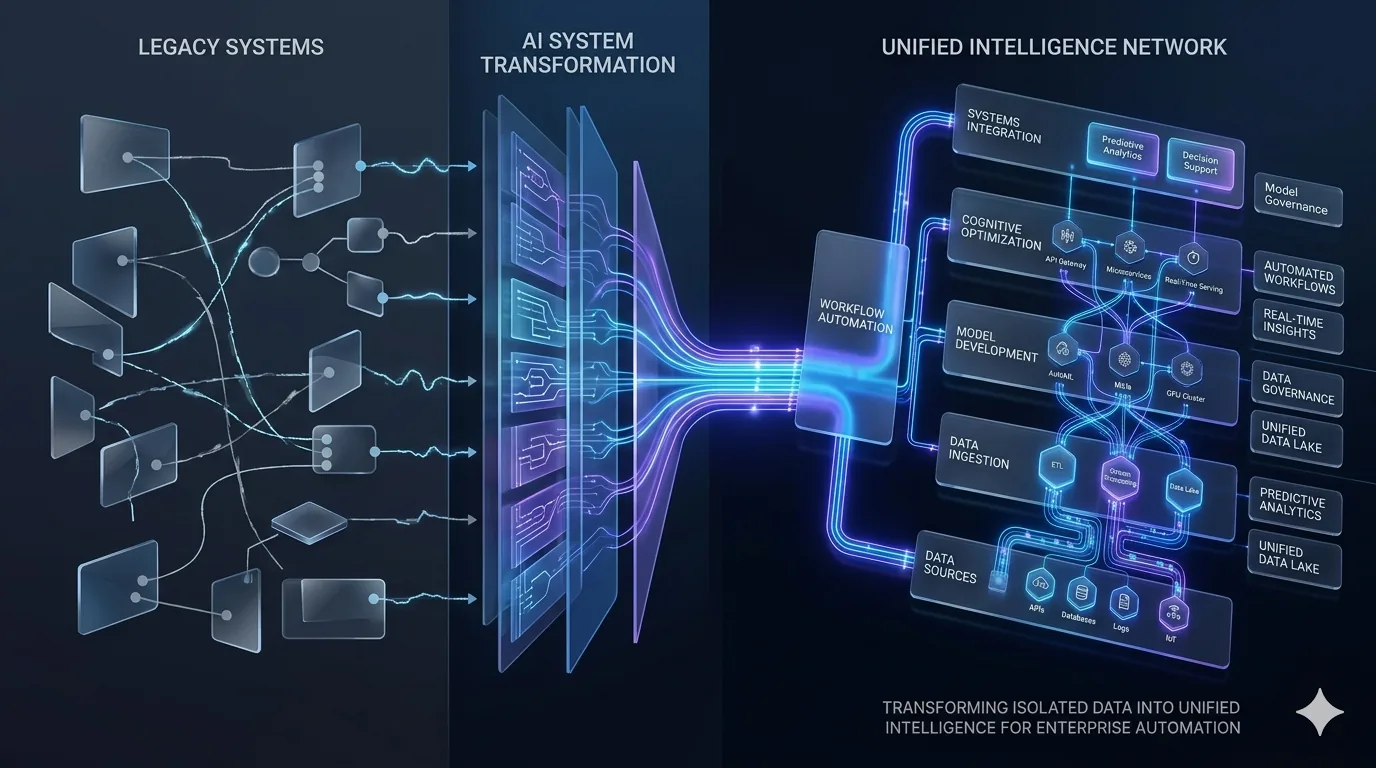
One of the most common questions in AI consulting is also one of the most misunderstood: what is the actual difference between AI workflows, custom AI systems, and agentic AI? The three terms are used interchangeably in marketing materials and often conflated in board-level discussions — but they describe fundamentally different things.
They solve different problems. They require different conditions to work. They carry different governance implications. And they create value at very different timescales. Getting this distinction right is not an academic exercise — it is the difference between AI investments that produce measurable returns and ones that produce impressive demos and expensive disappointments.
This guide provides a complete comparison of all three, with clear guidance on when to use each and how to sequence them for sustainable, scalable AI adoption.
The Foundation: Why These Three Categories Matter
Most AI tools, platforms, and systems that businesses encounter today fall into one of these three categories — even if the vendors do not describe them in these terms. Understanding the category helps you evaluate what a tool actually does, what it requires to work, and what it cannot do.
The three categories are not a hierarchy of sophistication where "agentic AI" is simply better than "AI workflows." They are different capabilities suited to different problems. A business that deploys an agentic AI system before its workflows are stable and its data is clean will fail. A business that deploys AI workflows as a deliberate first investment creates the foundation that makes everything else work.
AI Workflows: Automating Repetitive Processes
AI workflows are systems that automate structured, repeating processes by handling the variation that traditional rule-based automation cannot. They sit at the intersection of AI and process design — combining machine learning, natural language processing, and intelligent routing to take a high-frequency operational process and run it automatically.
What AI Workflows Do
An AI workflow takes a defined input (an email, a document, a form submission, a database event), processes it intelligently (classifying the content, extracting key information, making a routing decision, generating a structured output), and delivers a defined result (a completed document, a routed ticket, a drafted communication, a logged entry) — all without requiring manual handling of each individual item.
The "AI" in AI workflows matters specifically because it handles variation. A traditional automation script requires the input to match a template exactly. An AI workflow can handle an invoice that is formatted differently from last month's, a support ticket that combines two issue types, or an email that uses phrasing the system has not seen before. This flexibility is what makes workflows operational rather than brittle.
Common AI Workflow Applications
Document processing:Invoice extraction and accounts payable routing, contract review and clause flagging, insurance claim pre-processing, compliance document verification.
Communications handling:Customer enquiry triage and initial response drafting, supplier communication routing, HR candidate screening communications, internal helpdesk ticket classification.
Data processing:CRM data enrichment and deduplication, expense categorisation and policy compliance checking, inventory update processing, regulatory reporting data preparation.
When to Use AI Workflows
Use AI workflows when a process is high-frequency (runs daily or weekly), high-effort (consumes significant staff time per occurrence), well-defined (inputs and outputs are consistent in type if not in exact form), and measurable (you can track time, volume, and accuracy before and after). This describes most operational business processes — which is why AI workflows are almost always the right starting point.
The ROI from a well-designed AI workflow is typically visible within 60–90 days of deployment. A Singapore SME processing 400 invoices per month at 15 minutes per invoice saves 100 staff-hours monthly from a single workflow automation — typically worth S$4,000–S$8,000 per month in staff time, before accounting for accuracy improvements and error reduction.
Custom AI: Decision Quality and Forward-Looking Intelligence
Custom AI goes beyond process automation to deliver something qualitatively different: the ability to see patterns in your business data that are not visible to the human eye, and to make predictions about future events with quantified confidence.
What Custom AI Does
Custom AI uses historical data from your specific business — transactions, customer interactions, operational records, sensor data, financial results — to train models that identify patterns, make predictions, and surface insights that would otherwise remain invisible in the data.
Unlike generic AI tools trained on broad public data, custom AI models are calibrated to your specific operational context. A demand forecasting model trained on a Singapore retailer's three years of sales data, factoring in local holidays, weather patterns, and supplier lead times, will outperform a generic forecasting tool on that retailer's specific problem by a significant margin.
Common Custom AI Applications
Predictive analytics:Demand forecasting, churn prediction, lifetime value modelling, next-best-action recommendations, maintenance failure prediction, financial risk modelling.
Pattern detection:Fraud detection, quality defect identification, compliance anomaly detection, inventory shrinkage pattern identification.
Decision support:Pricing optimisation, resource allocation modelling, project risk scoring, credit decisioning support, clinical pathway recommendation.
When to Use Custom AI
Use custom AI when your operations are producing consistent, structured data (typically after 6–18 months of AI workflow deployment), when decisions are high-stakes enough that improving their accuracy creates measurable business value, and when the forward-looking signal (what is coming next) is more valuable than historical reporting (what happened).
Do not use custom AI before Stage 1 workflows are running. The data quality required for reliable custom AI models typically does not exist in organisations that have not structured their operational data through workflow automation first.
Agentic AI: Autonomous Execution With Governance Controls
Agentic AI represents a fundamental shift from AI as a tool that supports decisions to AI as a system that takes actions. An agentic AI system can execute multi-step tasks, make contextual decisions within defined parameters, interact with external systems and people, and operate continuously across extended time horizons — all without requiring step-by-step human instruction.
What Agentic AI Does
Agentic AI systems operate as autonomous agents within bounded domains. A customer service agent can handle a complex service request end-to-end: understanding the issue, retrieving account information, applying policy rules, making a resolution decision, communicating the outcome to the customer, and logging the interaction — without a human agent being involved at any step unless escalation is triggered.
A procurement agent can monitor supplier performance data, identify emerging supply risks, identify alternative suppliers, request competitive quotes, evaluate proposals against criteria, draft purchase recommendations, and initiate the approval workflow — compressing a multi-day manual process into minutes.
The Governance Imperative for Agentic AI
Agentic AI is not simply a more capable version of an AI workflow — it is a categorically different governance challenge. When AI takes consequential actions autonomously, the requirements for accountability, explainability, and oversight become substantially more demanding.
Bounded permissions— the system must be strictly constrained to act only within its defined scope. A procurement agent should have no ability to approve purchases above a defined threshold without human sign-off. A customer service agent should have no ability to issue refunds above a defined amount without escalation.
Approval checkpoints— for decisions above a defined risk threshold, the system must surface a human decision point rather than act autonomously. The threshold should be calibrated to the specific risk profile of the domain.
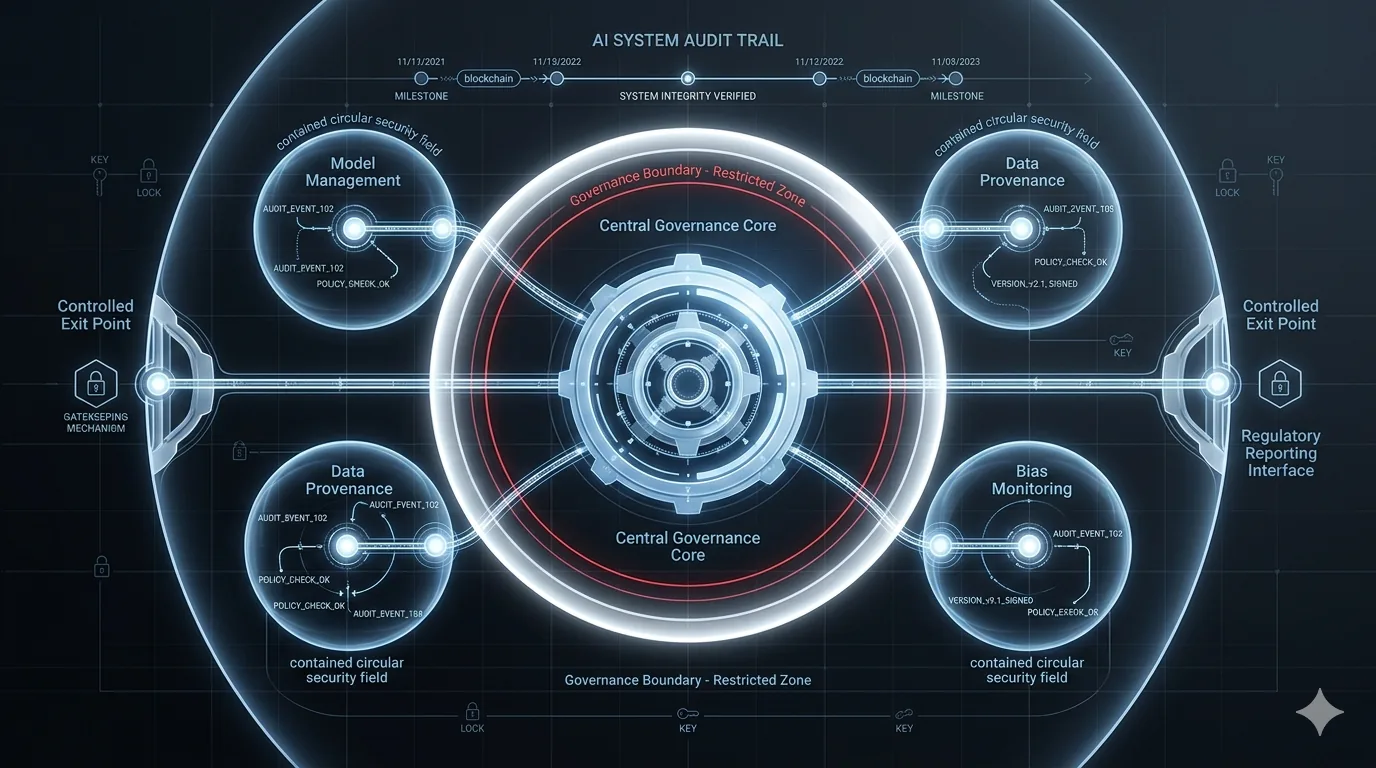
Audit trails— every decision the agent takes must be logged with sufficient detail to explain the decision and reconstruct the decision process for any subsequent review.
Human escalation paths— the system must have clear, tested mechanisms for escalating situations it cannot handle within its defined parameters to a human operator, rather than attempting to act outside its competence.
When to Use Agentic AI
Deploy agentic AI only when: workflows in the relevant domain are stable and well-governed, the decision logic the agent needs to apply is clearly defined and documented, governance controls (bounded permissions, approval checkpoints, audit logging) are designed and tested before deployment, and your team has the capability to monitor, review, and override the agent's decisions.
Organisations that rush to agentic AI without this foundation do not get faster value — they get ungoverned systems that expose the business to regulatory, operational, and reputational risk that outweighs the efficiency gains.
Comparing All Three: A Decision Framework
| Dimension | AI Workflows | Custom AI | Agentic AI |
|---|---|---|---|
| Primary function | Automates processes | Improves decisions | Executes autonomously |
| Data requirement | Low — needs clear process | Medium — 12–24 months clean data | High — stable workflows + clean data |
| Governance complexity | Low to medium | Medium | High — mandatory |
| Time to ROI | 60–90 days | 6–12 months | 12–18 months |
| Best first use | Invoice processing, HR onboarding, IT helpdesk | Demand forecasting, churn prediction | Customer service, procurement, monitoring |
| When NOT to use | When process is undefined or highly variable | When data is inconsistent or insufficient | When governance controls are not in place |
How to Choose Your Starting Point
For the vast majority of Singapore businesses, the right starting point is AI workflows — almost always. Not because workflows are simple, but because they create the stable operational foundation that custom AI and agentic AI require to work reliably.
The decision framework is straightforward:
If your team spends significant time on repetitive, well-defined processes— start with AI workflows. This describes most organisations, which is why workflows are the almost universal starting point.
If your workflows are running reliably and you have 12+ months of structured operational data— consider custom AI for your highest-stakes decision areas. Focus on problems where improving decision quality creates direct, measurable business value.
If you have stable workflows, clean data, clear decision logic, and robust governance controls in place— explore agentic AI for domains where continuous autonomous operation would create significant operational leverage.
The GARD Framework — Governance, Architecture, ROI, Defensibility — applies at every stage. It ensures that whichever type of AI you deploy, the system is integrated into real operations, accountable, measurable, and resilient to the scrutiny that comes with consequential automated decisions.
Building AI That Scales
The most expensive mistake in AI adoption is treating all three types as interchangeable alternatives and choosing based on what sounds most impressive. Agentic AI headlines attract board attention — but deployed without the foundation that workflows and custom AI create, it produces ungoverned systems that create more problems than they solve.
The organisations that build lasting AI capability in Singapore follow the sequence: automate the workflows first, build intelligence on the clean data that produces, then deploy autonomy only when governance controls are in place. Each stage makes the next one better. Each stage creates real, measurable value on its own timeline.
The question is not which type of AI to use. It is where to start — and how to build from there.